
New Report for World Press Freedom Day Uncovers Five Findings That Should Change How Nigerian PR Engages Journalists
Every year, World Press Freedom Day invites us to talk about journalism. The speeches tend to be generous, the tributes sincere, and the conversation safely distant from the room most of us actually work in. This year, we wanted to do something different. We wanted to ask the journalists themselves.
The result is The Future of Media & PR Collaboration in Nigeria, a practitioner intelligence report we are publishing under the banner The Voices Behind the Headlines. It draws on structured responses from working journalists and media practitioners across print, digital, broadcast, and independent platforms, representing 17 media organisations including The Guardian Nigeria, PUNCH Newspapers, BusinessDay Media, Nigerian Tribune, the News Agency of Nigeria, Technext, The Cable, Peoples Gazette, Afrocritik, and TRT World, among others. We combined those responses with the most current global data on press freedom, institutional trust, AI adoption in newsrooms, and media economics.
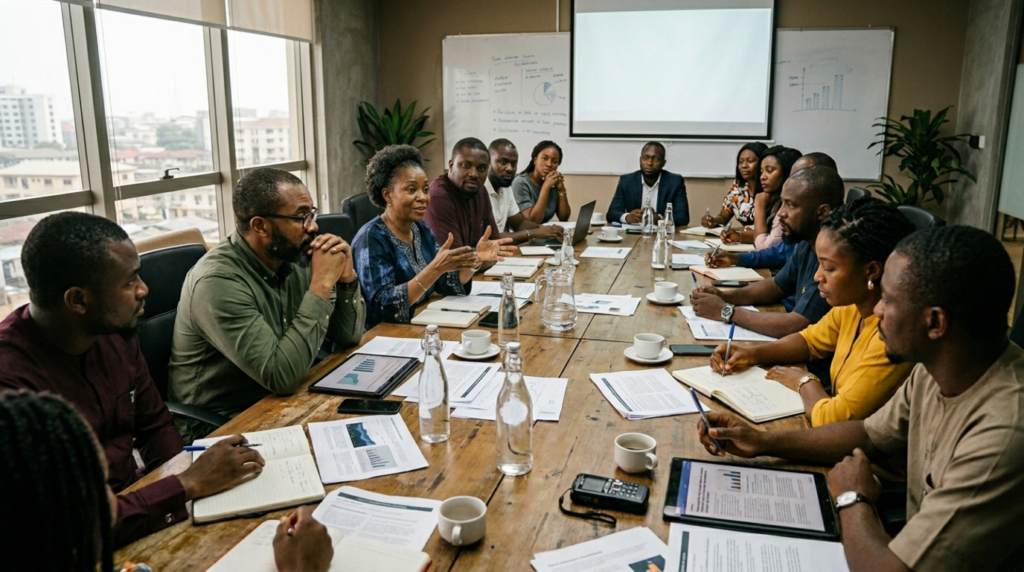
The question that started the project was simple enough: on World Press Freedom Day, what do Nigeria’s working journalists actually think about the state of their profession, the tools reshaping it, and the communications industry they navigate every day? The answers were candid in ways that surprised even our own research team. Journalists spoke about financial fragility, editorial compromise, the quiet weight of self-censorship, and a communications industry that too often treats media relations as a transaction when what the moment demands is a relationship.
This report is not a critique of either industry. It is an honest accounting of where both stand and what each owes the other. Nigeria’s media ecosystem is more resilient than it is often given credit for. The journalists represented in these pages are talented, committed, and remarkably clear-eyed about the conditions in which they work. They deserve communications partners willing to meet that standard. What follows is our invitation to the industry to begin that conversation.
Five findings at the centre of the report
The funding crisis is the story behind the stories. Financial fragility is not a background condition in Nigerian journalism. It is the primary operating reality, the thing that shapes what gets covered, how it gets covered, and whether the people doing the covering can sustain careers worth building. The Reporters Without Borders (RSF) 2026 World Press Freedom Index ranks Nigeria 112th out of 180 countries, still classified as “difficult” despite a ten-place improvement on the previous year. Globally, 160 out of 180 countries are contending with financially unstable media outlets. Nigeria is not an outlier. It is the norm, and that should alarm us more than it does.
AI has entered Nigerian newsrooms, but the ethical infrastructure has not kept pace. The majority of practitioners we heard from use AI tools for research, editing, transcription, and writing assistance. Their concerns are remarkably consistent: the risk of intellectual laziness, the erosion of originality, and the growing potential for AI to serve disinformation at a scale no newsroom is resourced to counter. Globally, only 12% of audiences are comfortable with news produced entirely by AI. Nigerian newsrooms are adopting these tools without the ethical guardrails that better-resourced newsrooms elsewhere can draw on, and nobody seems to be talking about what happens next.
Social media has restructured distribution without resolving the economic problem. Nigeria’s 107 million internet users represent a vast potential audience, but audience scale has not translated into media sustainability. The platforms captured the attention. The economics of that attention still flow somewhere else entirely. For journalists, this means producing more content across more platforms with fewer resources and less certainty that any of it will sustain the institution that employs them.
Influencers and journalists operate in different ecosystems, not competing ones. This came through clearly and consistently. Professional journalism is defined by verification, editorial accountability, and the pursuit of objectivity. Influencers operate under different expectations and are not held to equivalent standards. The confusion between the two, sometimes encouraged by communications professionals who find influencer engagement easier to manage, does a disservice to both groups and weakens the credibility of the information ecosystem as a whole.
The media-PR relationship is transactional when it should be structural. This may be the most actionable finding in the entire report. What journalists want from communications professionals is not complicated, but it does require effort: earlier engagement in the story development process, pitches that demonstrate genuine knowledge of their beat, transparency about sponsored content, and relationship-building that begins before either side needs anything from the other. The message is clear. Stop treating journalists as distribution channels and start treating them as professionals whose work your clients ultimately depend on.
The numbers worth sitting with
Some data points from the report carry weight that a summary cannot fully convey, but they are worth noting here. 84% of Nigerians worry about distinguishing real from fake news online, the highest rate among all countries surveyed globally in the Reuters Institute Digital News Report 2025. Nigeria’s income-based trust gap in media has reached 26 points, an all-time high that has doubled since 2022, according to the Edelman Trust Barometer 2026. These are not abstract indicators. They describe the environment in which every journalist quoted in this report goes to work each morning, and in which every communications professional asks to be taken seriously.
What comes next
We did not produce this report to mark a calendar date and move on. The findings here point toward work that needs doing, conversations that the communications industry has been deferring, and standards that both professions will need to hold each other to if the relationship between media and PR in Nigeria is going to mature into something worthy of the people on both sides.
The full report is available for download, and we welcome responses from journalists, communications practitioners, and anyone with a stake in the quality of Nigeria’s public information environment.
The Future of Media & PR Collaboration in Nigeria was produced by Carpe Diem Solutions, a public relations, reputation management and strategic communications agency based in Lagos.